Within months of being in Ayemenem, I turned into a part of its landscape–a wild child with calloused feet who knew every hiddenth path and shortcut in the village that led to the river. I lived outdoors and went home as seldom as possible.
Arundhati Roy
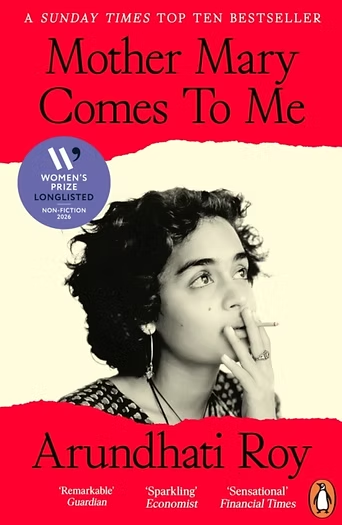
In her memoir Mother Mary Comes to Me, Arundhati Roy invites readers to follow her life from childhood to her mother’s death in 2022. A light read, the memoir steadily pulls you in to see, feel, and comprehend the inner turmoil and struggles of the young Arundhati, including her bitter and sweet relationship with her educationist mother, Mary Roy. The memoir’s primary objective seems to be to define Arundhati’s relationship with her mother. It encapsulates how fright and flight experiences with her mother played a key role in defining her key moments and transforming her into a spirited individual carving her own space as an author and activist fighting for the rights of tribals by adventurously leaving safe havens (metaphorically referring to her home and relationships) for riskier and lonelier, yet fulfilling, paths.
I am your mother and father and I love you double.
Mary Roy to Arundhati Roy
The memoir, for the first time, gives us an insight into Arundhati’s vulnerabilities and emotions, similar to anyone in flesh and blood, covering her insecurities towards life due to the absence of a father, a steady family and its secure environment, a home, and presence of an authoritarian and strict disciplinarian mother whose heart was more inclined toward her school and students than apparently toward her children. She delicately strings multiple incidents together, right after the separation of her Syrian Christian mother from her Bengali father due to his troublesome drinking habit, laying the foundation for departure from a formal family setting. The drastic changes in financial and social security also led to a sea change in the approach of her mother, especially after being denied shelter in her paternal home, which led to a series of relentless legal interventions, challenging the age-old patriarchal Syrian Christian rules unapologetically accepted by all, to allow her to continue staying in the house. These eye-opening and patriarchal episodes turned Mary into a relentlessly vindictive woman diligently trying to salvage her lost respect. Known to the world as a great educator, Mary immersed herself in running a makeshift school, which later emerged as a legendary school in Kottayam, with buildings designed by Laurie Baker, a British-Indian architect focused on sustainable, cost-effective architecture.
I, as a reader, can divide the entire memoir into three parts: the first part deals with the childhood days of Arundhati Roy in her maternal hometown Aymanam in Kottayyam, her stint in the architecture school and the taste of freedom and adventure that evolved as a free-spirited person, and the third part highlights her evolution as an author and struggles as a daughter with ailing and starkly difficult parents. In the first part, Arundhati discovers the unimaginably rough and unpredictable behavior of her mother toward her and her brother. It vividly talks about her escapes into nature and time spent near the Meenachi River, and her realization of her inner insecurities and anxieties. She unwraps her childhood insecurities and anxieties by discussing how the absence of a male figure around her and her single mother’s long-drawn legal battle against traditionally accepted property rights of her community led to their ostracization from the community, disrespect by condescending relatives, and deliberate preying due to the fraying safety of the community around her and her family.
Mary’s dedication toward her school and its students, and her neglect and draconian behavior toward her children, such as throwing a series of invectives and unleashing corporal punishment for not performing well at school, left a deep, scarred impact on her and her brother’s minds. With the safety net frayed, they became easy prey for others. Whether it’s a close escape from abuse by an elderly relative or the improper touch of a relative when he came to visit her in college days, Arundhati learned at a young age to be near her mother, rather than being shifted to her relatives’ homes during her mother’s illness. Such was her anxiety level during her childhood days that she discreetly prayed for the long life of her mother as she had started experiencing severe asthma attacks. The absence of her mother would have pushed Arundhati and her brother into an unsafe environment with her relatives. We also learn about other condescending behaviors that young Arundhati had to witness at her relatives’ homes, such as showing off new clothes and other material things. In the first part, it seems as if her life and her mother were preparing Arundhati for bigger journeys and roles.
The second part of the novel covers her escape from her mother and home and her adventures at an architecture school in Delhi, where she learns to survive and fight, preparing herself for a bigger and greater battle. It is all about her voyage towards freedom, her experiences of survival, emotional and physical connectedness through the newly discovered emotion of love, unforgettable and everlasting friendship, and an investigation into her inner self. She organically weaves her stories around the political and social events unfolding at the same time.
[To be continued]
Leave a Reply